
Do justice. Love kindness. Walk humbly with your God.
Micah 6
6 Hear what the Lord says:
Rise, plead your case before the mountains,
and let the hills hear your voice.
2 Hear, you mountains, the case of the Lord,
and you enduring foundations of the earth,
for the Lord has a case against his people,
and he will contend with Israel.3 “O my people, what have I done to you?
In what have I wearied you? Answer me!
4 For I brought you up from the land of Egypt
and redeemed you from the house of slavery,
and I sent before you Moses,
Aaron, and Miriam.
5 O my people, remember now what King Balak of Moab devised,
what Balaam son of Beor answered him,
and what happened from Shittim to Gilgal,
that you may know the saving acts of the Lord.”6 “With what shall I come before the Lord
and bow myself before God on high?
Shall I come before him with burnt offerings,
with calves a year old?
7 Will the Lord be pleased with thousands of rams,
with ten thousands of rivers of oil?
Shall I give my firstborn for my transgression,
the fruit of my body for the sin of my soul?”
8 He has told you, O mortal, what is good,
and what does the Lord require of you
but to do justice and to love kindness
and to walk humbly with your God?
The mountains are the witnesses that the Prophet Micah calls. They’ve watched land get taken, debts pile up, and families pushed out. They’ve seen who benefits and who disappears.
The Prophet Micah is speaking to the people of Judah in a time thick with fear. The Assyrian Empire is expanding and threatening to take Judah next. The northern kingdom has already fallen. People with power can read the signs, and they start preparing. Not by changing how they live, but by insulating themselves.
Land is consolidated. Courts tilt toward the wealthy. Influence is bought. Protection is purchased. Money becomes the difference between safety and exposure. This way of living settles in. You need food, you buy it. Clothing, you buy it. Permits, land, legal outcomes, trade deals, you buy them. Relationships flatten into transactions. Survival depends on access.
That same transactional life philosophy bleeds into faith practice.
If money secures everything else, why wouldn’t it secure God’s favor too? So the people escalate. Bigger sacrifices. More extravagant offerings. Priests and prophets are willing to bless the system as long as they’re paid. Faith becomes another tool for managing fear.
Micah speaks for God into the middle of this.
“What have I done to you?
How have I failed you?”
Micah reminds the community of their slavery in Egypt. No autonomy. No protection. Then God’s deliverance. God provides food in the wilderness. Survival that arrived when they had nothing to trade. Grace that was freely theirs as God’s people.
These are distant memories that have faded from the ways that God’s people live their lives. God’s people ask for God’s favor.
What will it take?
Burnt offerings. Thousands of rams. Rivers of oil. Even their children, if that’s the price. If life feels unstable, maybe faith can smooth things over. Micah refuses the premise.
You can’t buy God.
You can’t manage God.
You can’t secure yourself this way.
The problem isn’t the absence of faith. It’s faith practice shaped by fear and control. Ritual becomes cover. Excess replaces responsibility. God is reduced to someone who can be handled.
Micah answers plainly.
Do justice.
Love kindness.
Walk humbly with your God.
Justice isn’t abstract, Micah points to it throughout his message to the people. Just looks like land returned instead of seized, in wages paid instead of withheld, courts that didn’t quietly favor people with money. It showed up when an economy stopped grinding the vulnerable, so a few could stay comfortable. Kindness wasn’t about being pleasant. It meant staying with neighbors who were crushed by debt and displacement. Choosing people over profit. Refusing to look away when staying present costs you something real. Humility meant remembering how exposed they once were, how quickly everything could be lost, how survival had come to them before without leverage or power, through intervention they did not control.
Micah puts all of this before the court of creation because the consequences of injustice and exploitation are visible. Fields stripped for profit. Water polluted. Communities hollowed out. Fear normalized.
That world is not ancient.
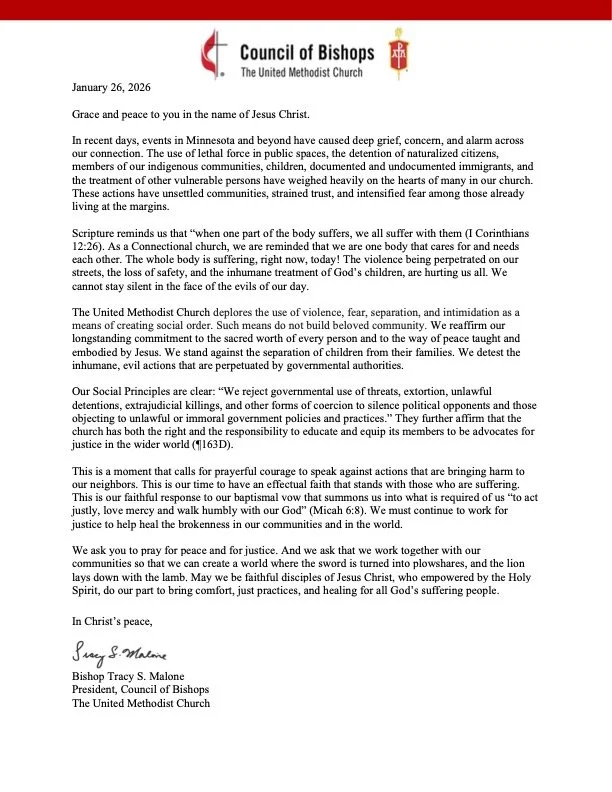
We see it now in government-sanctioned lethal force used in public spaces. In the arrest and detention of citizens. Indigenous communities are pushed aside. Children are separated from their families. People are treated as threats instead of neighbors. We see it when fear is used to create social order, and violence is defended as necessary.
This week, the bishops of the United Methodist Church named this plainly. These actions fracture communities. They deepen fear among those already living at the margins. They harm the whole body.
Faith practice shaped by fear will always justify harm. It will call violence protection, and separation order. It will ask how to stabilize the system, rather than who is being crushed by it.
Micah doesn’t offer a workaround.
Do justice.
Love kindness.
Walk humbly with your God.
Not as private virtues.
Not as spiritual language.
As a public practice that refuses to make suffering the price of order.
This is the worship that God wants.
Want to Go Deeper?
This reflection isn’t about abstract belief or private spirituality. It’s about how faith actually takes shape under pressure. About what happens when fear sets the terms and what it looks like to refuse them. About practicing justice, kindness, and humility in public, even when it costs something.
If you want to keep exploring faith as a lived practice that tells the truth about harm and insists on another way of living together, I write a weekly email that continues that work.
You’re welcome to subscribe and keep the conversation going.